One block, several passes
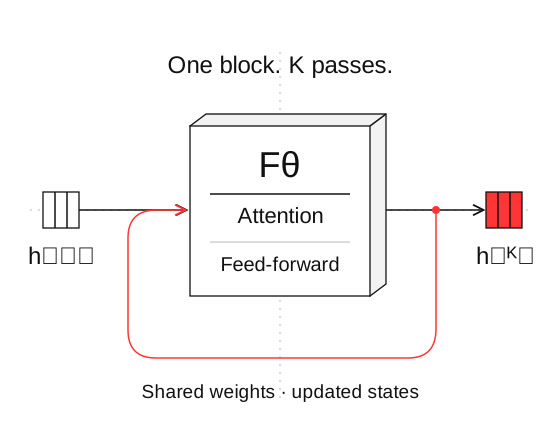
A looped transformer applies a shared block repeatedly to its hidden states—the internal representation of a sequence. Each pass lets attention mix information between positions, then a feed-forward network transforms the representation at each position. Universal Transformers explore this idea of recurrence through depth.
Sharing weights can reduce the number of distinct parameters compared with stacking separate blocks. Every extra pass still costs computation, and more passes do not guarantee better results. This loop refines hidden states within a step; predicting the next audio token is a separate operation.
Attention with a direction
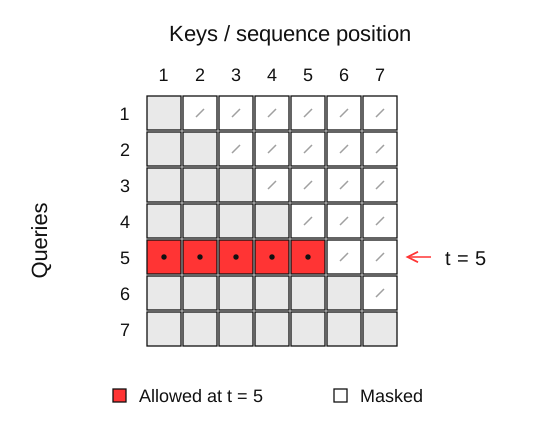
In a causal transformer, a position can attend to itself and earlier positions. Later positions are masked. The triangular pattern makes that rule explicit: the representation used to predict what comes next cannot look ahead at future tokens.
The same rule can be used while processing a training sequence in parallel and while generating tokens one step at a time. Some audio systems use other attention patterns; this diagram describes the causal case.
From a waveform to discrete codes
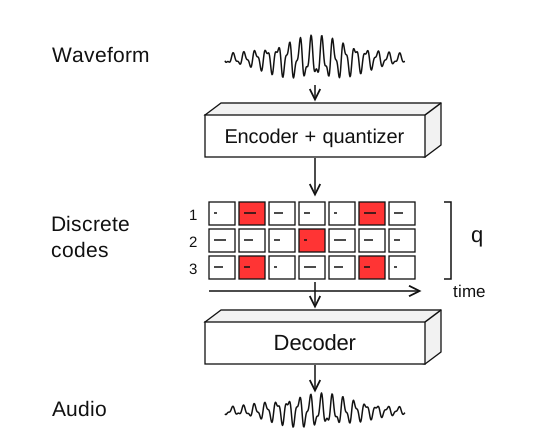
A neural audio codec converts a dense waveform into a shorter sequence of learned representations. Quantization maps those representations to entries in discrete codebooks. A decoder reconstructs audio from the resulting codes.
Residual vector quantization, used in SoundStream, represents an encoding through successive codebook levels. These discrete sequences give an audio language model a vocabulary to predict. The number of levels and the frame rate depend on the codec; the diagram does not prescribe either for Rivet.
Generate, decode, continue
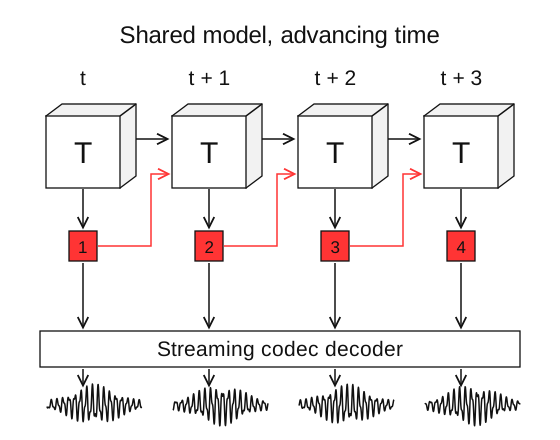
An autoregressive audio model predicts the next token from the available context, appends it, and continues. AudioLM demonstrates language modeling over discrete audio representations. Previously computed attention keys and values can be cached during causal generation to avoid recomputing the entire prefix.
With a codec designed for streaming, a growing sequence can be decoded into successive audio chunks. A chunk may require several tokens and some buffering; one token is not necessarily one playable frame. End-to-end latency also depends on the codec and the inference implementation.
How to read these diagrams
These are original, simplified schematics of general research ideas. They are not a specification of Rivet’s architecture or a report of measured results. Normalization, residual connections, positional information, conditioning, and training objectives are omitted so each drawing can focus on one mechanism.